Mixed-Subjects IRT Calibration
Source:vignettes/mixed-subjects-workflow.Rmd
mixed-subjects-workflow.RmdThis vignette shows the recommended mixed-subjects workflow for a
unidimensional 2PL model using the marginal maximum-likelihood (MML)
estimator (fit_mixed_subjects_mml). The package expects
three item response matrices with no respondent IDs and the same
ordering of item columns:
-
observed: rows of binary human item responses -
predicted: rows of binary LLM-predicted item responses for the human respondents; rows must be ordered to correspond to respondents inobserved -
generated: rows of additional binary LLM-generated item responses (typically ), generated from the same model and procedure aspredicted
All three matrices must contain binary responses
.
Probability (fractional) predictions are not accepted,
as they are not a valid likelihood input for the MML IRT objective and
break the correction. If your prediction model outputs probabilities,
sample binary responses from them first (e.g. rbinom).
The fitted objective is
where is a vector of item parameters and each is the true IRT marginal negative log-likelihood, with posteriors recomputed from the current candidate at every gradient step. Setting recovers the human-only MML calibration. See the Choosing Lambda vignette for the specific background on why the MML objective is preferred over expected-count based estimators.
Simulate example data
library(mixedsubjectsirt)
library(ggplot2)

set.seed(242424)

n_human    <- 400
n_generated <- 1200
n_items    <- 8

true_pars <- data.frame(
  item = paste0("Item", seq_len(n_items)),
  a    = seq(0.8, 1.6, length.out = n_items),
  d    = seq(-1.1, 1.1, length.out = n_items)
)
true_pars$b <- -true_pars$d / true_pars$a

theta_human <- rnorm(n_human)
observed    <- simulate_2pl(theta_human, true_pars)

# Strongly informative predictions. On the n labeled subjects, predictions
# match human responses (the F = Y benchmark from the simulation study), and
# N additional unlabeled responses are drawn from the same 2PL. This is
# the "good predictor" regime, where the method should lean on unlabeled data.
# (Further down we show the complementary case of an uninformative predictor,
# where the criterion instead drives lambda to 0.)
predicted <- observed
generated <- simulate_2pl(rnorm(n_generated), true_pars)
Step 1: Fit the human baseline
Baseline models are estimated by marginal maximum likelihood with
fit_2pl(), using the same objective and quadrature as the
mixed-subjects estimator below.
human_start <- fit_2pl(observed)Step 2: Fit the MML mixed-subjects model
fit_mixed_subjects_mml() uses a MML-based EM procedure
for iterative estimation at a given
value. If you have a value of
already (say from a pilot study or previous ability tuning), the model
can be estimated directly here.
mixed_mml <- fit_mixed_subjects_mml(
  observed  = observed,
  predicted = predicted,
  generated = generated,
  lambda    = 0.5,
  initial_pars = human_start$pars
)

mixed_mml
#> mixedsubjectsirt 2PL fit
#>   items:      8
#>   lambda:     0.5
#>   loss:       4.91044
#>   convergence: 0
#>   estimator:  marginal MML PPI++
mixed_mml$item_pars
#>    item         a          d          b
#> 1 Item1 0.7431516 -1.0825771  1.4567379
#> 2 Item2 1.0067305 -0.7278416  0.7229756
#> 3 Item3 0.8547961 -0.4113343  0.4812075
#> 4 Item4 1.0999070 -0.1453191  0.1321195
#> 5 Item5 1.1673633  0.1875515 -0.1606625
#> 6 Item6 1.2566354  0.4923056 -0.3917648
#> 7 Item7 1.5526282  0.8477934 -0.5460376
#> 8 Item8 1.5472382  1.1508463 -0.7438068
Step 3: Select by ability-score risk
tune_lambda_ability_risk() with
fit_fn = fit_mixed_subjects_mml selects the
that minimizes propagated ability-score risk
(where
is the Louis-corrected marginal sandwich covariance).1 By default this is
done by direct 1-D optimization over [0, 1]. The final fit
from this optimal
is also returned as the best_fit object within the output
list, so the user is not required to call
fit_mixed_subjects_mml again.
ability_tuned <- tune_lambda_ability_risk(
  observed     = observed,
  predicted    = predicted,
  generated    = generated,
  target_resp  = observed,
  initial_pars = human_start$pars,
  fit_fn       = fit_mixed_subjects_mml,
  control      = list(maxit = 200)
)

ability_tuned$best_lambda
#> [1] 0.792456
Because the predictor is highly informative, the approach selects a
near the theoretical maximum
.
As such, the method leans heavily on the unlabeled response data. (The
returned summary records each
the optimizer evaluated, with selection_risk = Inf for any
that failed to converge, so selection is protected against numerical
failures. When the predictor is uninformative the same criterion drives
to 0 instead; see below.)
Step 3b (recommended workflow): cross-fit tuning
tune_lambda_ability_risk() above estimated an
appropriate
and fits the final model on the same data used for this estimation.
Previous analysis of prediction-powered inference in finite samples
shows that estimating
on the data you also estimate model parameters with is optimistic. Item
parameters estimated this are biased in finite samples and may
undercover true parameter values.2
tune_lambda_ability_risk_crossfit() removes this bias by
tuning
on held-out data: each fold’s
is chosen using only out of fold item responses, and the final fit
combines them. Passing fit_fn = fit_mixed_subjects_mml for
the per-fold tuning and
final_fit_fn = fit_mixed_subjects_mml for the final fit
produces a single
scalar-
mixed subjects calibration fit (the fold-specific
’s
are averaged, weighted by fold size).
cf_tuned <- tune_lambda_ability_risk_crossfit(
  observed     = observed,
  predicted    = predicted,
  generated    = generated,
  initial_pars = human_start$pars,
  fit_fn       = fit_mixed_subjects_mml,
  final_fit_fn = fit_mixed_subjects_mml,
  n_splits     = 2,          # the standard PPI sample split (also the default)
  control      = list(maxit = 200)
)

cf_tuned$lambda_by_split   # one tuned lambda per held-out fold
#> [1] 0.8758023 0.8896980
cf_tuned$lambda_final      # fold-size-weighted scalar used for the final fit
#> [1] 0.8827501
The object cf_tuned$final_fit provides the final model
fit from calibration, and vcov(cf_tuned$final_fit) gives
its Louis-corrected covariance. We suggest use of the default
n_splits = 2, the standard PPI sample split (one half
tunes, the other estimates, then swap). You may notice the cross-fit
(here
)
sits above the same-data value
()
and above the perfect-predictor ceiling
.
That is expected and is not evidence of a better
:
with two folds each
is tuned on only half the labeled subjects
(),
and the PPI-optimal
grows as labeled data shrinks (it tracks
,
here
).
The fold
’s
are tuned for
but the final fit applies their average to the full sample, so they run
a little higher than
estimated in the same sample; in operational settings where
,
this difference shrinks to zero. Importantly, the reason to cross-fit is
not the
value, but to remove finite-sample item parameter bias. The cheaper
same-data tuner in Step 3 is fine for exploration; prefer the cross-fit
estimate for operational calibrations or further research.
Step 4: Inspect the covariance
vcov() on a scalar-lambda MML fit automatically uses
vcov_mixed_subjects_mml(), which applies Louis’
observed-information correction.3 Here, the bread is
rather than the EM complete-data Hessian alone.
Compare calibrations
human_only <- fit_mixed_subjects_mml(
  observed  = observed,
  predicted = predicted,
  generated = generated,
  lambda    = 0,
  initial_pars = human_start$pars
)

estimates <- rbind(
  data.frame(estimator = "human only",  human_only$item_pars),
  data.frame(estimator = "MML lambda = 0.5", mixed_mml$item_pars),
  data.frame(estimator = "MML ability-risk",
             ability_tuned$best_fit$item_pars)
)
estimates$true_b <- true_pars$b[match(estimates$item, true_pars$item)]
estimates$true_a <- true_pars$a[match(estimates$item, true_pars$item)]

ggplot(estimates, aes(true_b, b, colour = estimator)) +
  geom_abline(slope = 1, intercept = 0, linewidth = 0.4) +
  geom_point(size = 2) +
  labs(x = "True difficulty", y = "Estimated difficulty", colour = NULL) +
  theme_minimal()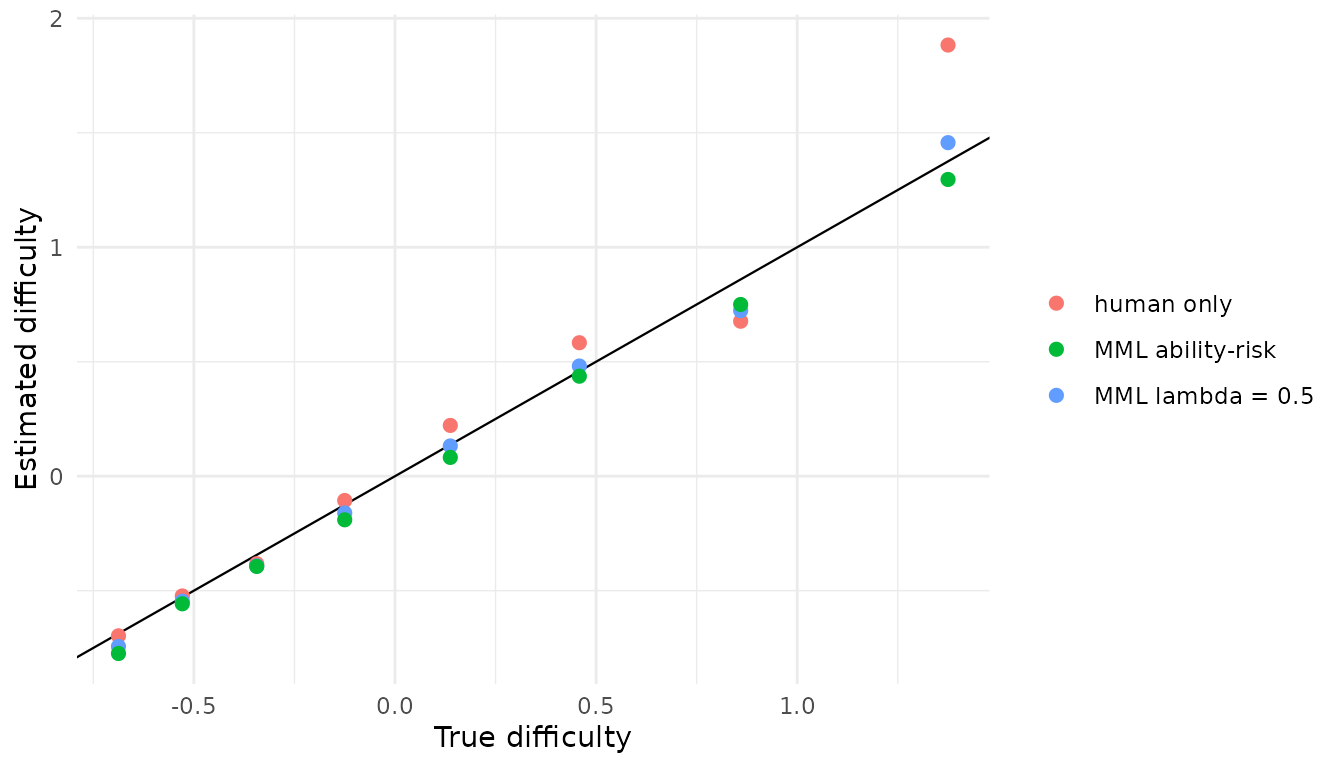
When the LLM is uninformative
While the method is able to efficiently exploit information derived
from a good predictor, it is also capable of rejecting useless
information derived from a bad one. Here we simulate responses that are
essentially unrelated to ability (drawn from scrambled item parameters),
so the paired correction between observed and
predicted carries no usable signal:
set.seed(242424)
bad_pars    <- true_pars
bad_pars$a  <- pmax(0.05, abs(rnorm(n_items, 0, 0.1)))   # near-zero slopes
bad_pars$d  <- rnorm(n_items, 0, 2)                       # difficulties unrelated to truth

predicted_bad <- simulate_2pl(theta_human, bad_pars)
generated_bad <- simulate_2pl(rnorm(n_generated), bad_pars)

tuned_bad <- tune_lambda_ability_risk(
  observed     = observed,
  predicted    = predicted_bad,
  generated    = generated_bad,
  target_resp  = observed,
  initial_pars = human_start$pars,
  fit_fn       = fit_mixed_subjects_mml,
  control      = list(maxit = 200)
)

tuned_bad$best_lambda   # expect ~0: the useless LLM is correctly ignored
#> [1] 0.03332135
The criterion drives , recovering the human-only item parameters. As such, the same tuning procedure both embraces informative predictions (as in the main example, ) and rejects an uninformative predictions ().
Validation
A full simulation study confirms the recommended workflow behaves as intended:
- -selection tracks predictor quality. A perfect paired predictor selects ; a useless predictor is down-weighted to .
- The Louis-corrected standard errors provide correct coverage. Across
all simulation conditions, including a useless or biased predictor,
vcov()on a scalar MML fit attains nominal Wald-interval coverage (~0.91/0.96) for both discriminations and intercepts, whereas the uncorrected EM-Hessian covariance under-covers (~0.71/0.79). - No average harm done to ability scoring. The tuned ability-score RMSE is no worse than the human-only calibration on average (every regime’s mean ) when the predictor is uninformative.
See the Simulation
Validation vignette for the full results, and
simulations/ in the source tree for the reproduction
code.